Connecting Through Story: My Experience of a Narrative 4 Story Exchange
Project Horizon is a global conversation experiment by executive coach and high-performance consultant Dr Tim Dutton. It aims to uncover diverse human perspectives by connecting with 100 remarkable people worldwide, linked through six referral-based chains.
ON THE GO? LISTEN TO THE INSIGHTS 🎧
If you’ve been following Project Horizon, you’ll know that it is a global storytelling experiment. I started with six people I already knew. My mom, my best friend, someone I met on my travels, and three people from different professional worlds I’ve worked in: sport, military and fitness. Each of them became a ‘chain starter’ and referred me on to someone they saw as interesting. After being introduced, I tend to spend around an hour listening to their story. What has their journey through life been like so far? What have they learnt along the way? And how might they see the world differently from me?
In April 2025, I started the sixth chain with an amazing guy I had worked with when supporting the military. By December 2025, the chain had grown to 16 links. Along the way, there had been:
- The military guy who started the chain
- An ex-army guy who now owns an MMA gym
- A Christian pastor
- An ex-Special Branch police officer
- A suspended teacher
- A physiotherapist
- Liverpool’s first female Brazilian Jiu Jitsu black belt
- A security guard who’s writing a book on philosophy
- A tarot card reader
- A personal trainer
- Another military guy
- A podcaster
- A retired comedian who once roasted Donald Trump
- Another comedian
And it was that final comedian who referred me to a man called Lee Keylock, the 16th connection in this chain. Lee was introduced as “one of the most emotionally intelligent people I’ve ever met”. Of course, that’s right up my street.
We connected just before Christmas 2025. After describing what Project Horizon is all about, Lee told me his story. And it was powerful.
In December 2012, a 20-year-old gunman attacked a school in Newtown, Connecticut. The gunman killed 20 children and six staff members. At the time, Lee was working as an English teacher at the high school in Newtown. In the chaos of the situation, and with the majority of school shootings in America taking place at high schools or colleges, the high school went into lockdown for three-and-a-half hours. Lee heard helicopters outside and the wailing of sirens and assumed it was his high school under attack.
When they emerged from the lockdown, it emerged that it was Sandy Hook Elementary School that had been attacked. The 20 children who were killed were aged between six and seven.
26 people had been brutally murdered that day, though 28 people had died. Lee believed it was important to include the shooter’s mother and the shooter himself among those who died. To leave them out would be to not tell the full story. And, as you will find out, Lee believes stories are incredibly important for the world.
The community of Newtown was understandably rocked by the tragedy. In the aftermath of the attack, and in searching for ways to support his students to heal, Lee came across a book called ‘Let the Great World Spin’ by Irish author, Colum McCann. He acquired enough copies for all his students from the publisher, and in the process was connected with and met Colum. After hearing about the hurting community of Newtown, Colum shared an idea he had been developing with entrepreneur, Lisa Consiglio. He wanted to help bring communities together by providing spaces for people to share their experiences. But not just telling their own stories. People take on one another’s stories and retell them in the first person, moving closer to another person’s lived experience through a method they call “radical empathy.” Something that would take significant courage, vulnerability, curiosity and imagination.
They decided to try it out with Lee’s students, but he was cognisant of not wanting to focus their stories on the tragedy that had happened. He didn’t want them to be defined by the attack. So, he created a safe and brave space for them to share. They ended up telling a variety of other stories about their lives, which he felt started to give them back their voice.
He and Colum realised the power of this exchanging of stories, both on the individual and community level, and began to experiment with the approach with different groups. A story exchange was organised with a school from Chicago, where the students were at high risk due to gang culture in the area. This was a school where there should have been more than 1100 attending each day, but only 300-400 were showing up.
A Google Hangout was organised, and the students shared stories of their lives. To begin with, it stuttered in a way you might expect of two groups of children from vastly different backgrounds looking at each other on a screen. By the end, though, the teachers couldn’t pull them away. They were talking about music, fashion, and poetry. They were connecting.
Lisa, Colum and Lee recognised they were onto something transformative, and intentionally launched Narrative 4 in schools, planting the seeds of what would become a global movement. Narrative 4 is a non-profit whose mission is to foster a global community of empathetic, courageous young leaders who use the power of storytelling to drive positive change.
Nowadays, Lee is Vice President of Global Impact for Narrative 4. They operate all over the world, including the Americas, Africa, Europe and the Middle East. Their methodology has developed significantly over the years, and they have highly-trained facilitators around the globe who guide people through their impactful Story Exchanges.
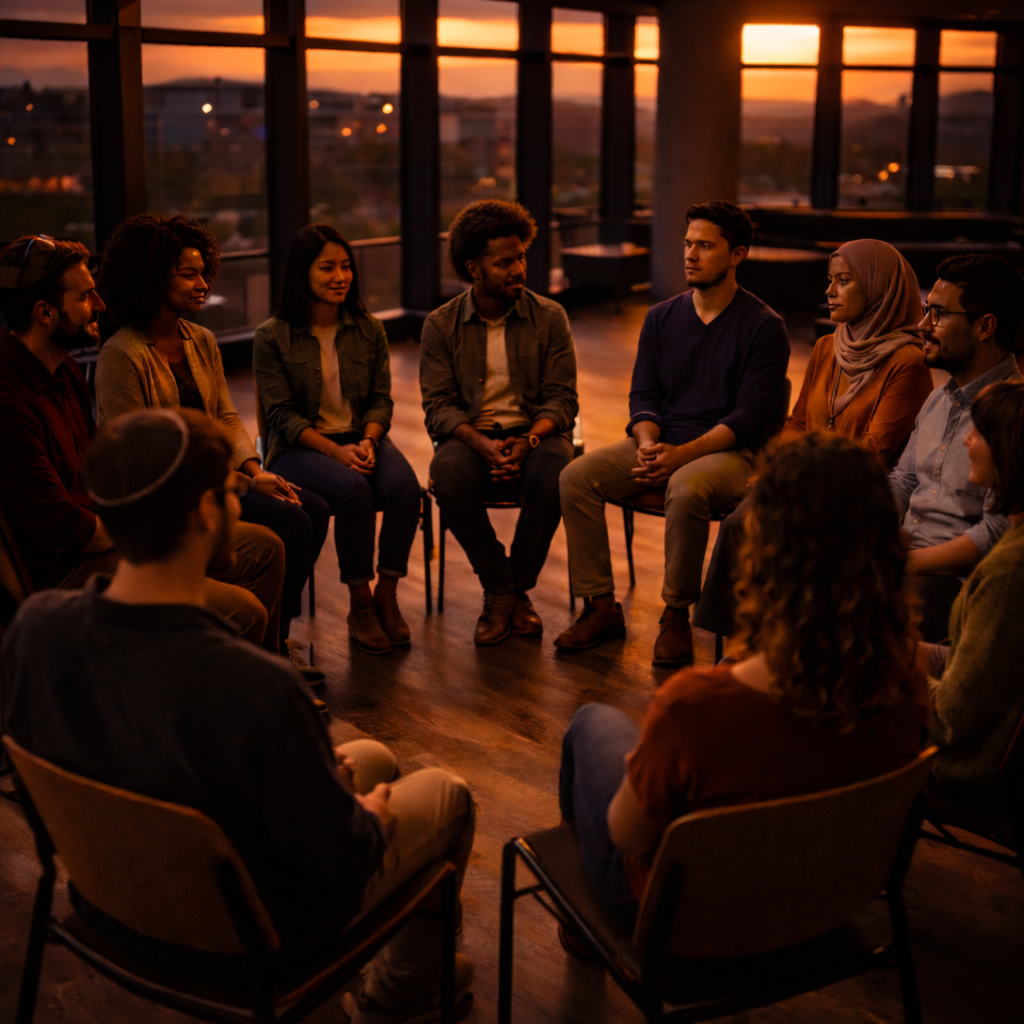
A Narrative 4 Story Exchange is quite simple in principle. A group of 8-12 people, from any background, come together in a circle and share stories which focus on human experiences. What makes it really unique is the process.
Each person brings a story with them based on a prompt like “Tell a story about a time when you felt proud of your community”. The group is split into pairs, and each person spends approximately 5 minutes telling their story to their partner. Uninterrupted. When the story is finished, the partner has 5 minutes to ask clarifying questions. Getting clear on the details is important for what is about to come.
After both people have shared their stories, all pairs return to the circle. Each person then has to retell their partner’s story to the group in the first person. They begin with “Hi, my name is [their partner’s name], and this is my story…”. When they finish their partner’s story, they say, “My name is [their partner’s name], and that was my story.”
The story exchange that I attended was held at the Brighton & Hove Jewish Community Centre on the south coast of the UK. I was told beforehand that the theme of the day was ‘interfaith’. Being a man of no faith, I googled the term.
“Interfaith refers to positive interactions, understanding, and cooperation between people of different religious, spiritual, or non-religious beliefs, focusing on shared values like compassion, peace, and service rather than just differences”.
I thought that sounded timely and relevant.
In attendance were Jewish people who served their local community in different roles. There was a Muslim who dedicated his time to fostering dialogue between different religious groups. There were a variety of other ‘identities’ such as school teachers and charity workers.
And myself. A guy who’d never done anything like this before.
Critically, there was another person there who held it all together. One of Narrative 4’s well-trained facilitators. Their facilitators perform a variety of important roles. Keeping the day on track is one role, as no matter how well-qualified and ‘grown up’ the people in the room are, it’s like herding sheep. A more important role, though, is creating a safe enough ‘space’ for the participants to be vulnerable enough and brave enough to share.
One way the facilitator did this in Brighton was by demonstrating the retelling of someone else’s story. It wasn’t perfect (although it wasn’t far off), but the point was to role model the bravery we’d all need to sit in front of someone else and tell their story.
Another way the facilitator settled any understandable nerves in the room was with some sticky notes. She handed us one each and asked us to write down one hope and one fear for the story exchange. The answers were pretty universal. Almost everyone hoped that their story was interesting enough (a proxy, I’m assuming, for hoping that we were interesting enough). And we all feared that we might not do our partner’s story justice when we retold it.
It seemed to be a common theme that people arrived at the story exchange with the belief that their own story wouldn’t be good enough. Not interesting enough. But after listening to everyone else’s stories being retold, I sensed that belief melt away in the room. I personally still felt slightly uneasy, though, as my story was the last to be retold. Listening to my own story eventually be retold – and being able to listen to my experience from the ‘outside’ – gave me a different perspective on it. I felt like I could see the interesting features in it that I don’t normally notice when I’m focused on the ‘performance’ of speaking. I heard and felt the emotions, and saw a deeper meaning to the experience.
Granted, the ‘facts’ of the story can be a little off when a stranger is retelling it – especially when it’s only a few minutes after hearing it. I had to stop myself from fact-checking to begin with. But once I got over that, my mind focused on the essence of the story instead. And to have the essence of my own human experience shared so thoughtfully was a really unique experience. I felt heard and seen in a way that seems rare in the fast-paced, ‘everything-now’ world we inhabit.
I did feel a little awkward while my story was being retold. As a result, I found myself staring at the ground as my partner spoke. I didn’t want to look at people, maybe out of fear that I’d see their face plastered with boredom. But when I looked up as my partner said the words, “My name is Tim, and that was my story”, I looked across the circle at two women. They were both wiping tears from their eyes. I sensed the room had been moved by the story, and I felt a rush of an unfamiliar feeling. That not only did my story matter, but that I mattered.
My name is Tim, and that was my story about a Narrative 4 Story Exchange.
For readers in the UK who’d like to arrange their own Story Exchange, please reach out to Julia Davis, who facilitated the amazing story exchange I experienced.
E: julia@narrative4.com.
For all other inquiries, visit https://narrative4.com/info-for/