5 Connections, 5 Insights: 81-85 of 100
Project Horizon is a global conversation experiment by high-performance coach and advisor Dr. Tim Dutton. It aims to uncover diverse human perspectives by connecting with 100 remarkable people worldwide, linked through six referral-based chains.
ON THE GO? LISTEN TO THE INSIGHTS 🎧
The Connections
81. Global Lead for Narrative 4, a Storytelling Non-Profit
82. Chief Conservation Officer educating students through wildlife
83. Bodybuilder and personal trainer in Australia
84. Retired Native American with a winding career
85. Poet, professor, and LGBTQ+ activist
Insight 81: How Are You Healing the World?
I wrote a feature piece about Connection 81 which details my experience of meeting Lee Keylock and the subsequent ‘story exchange’ I took part. You can read all about it here.
As a result, I’ll keep this insight short and (hopefully) powerful. I wanted to focus on a question which Lee asked me, rather than the other way around. And it’s one I haven’t forgotten since.
There’s context around why Lee asked me the upcoming question. Whilst I tend to shoot from the hip during conversations, following no set structure, during the second half of the project I began challenging everyone to do something.
The challenge was this: “If I gave you the opportunity to ask me one question – and only one – what would you ask?”
I must have tried the question once, found it impactful, and stuck with it. What felt important about the question to me was that the chosen question is often revealing about what people value most.
I found that by giving people only one question, they tended to be really thoughtful in which one they chose. Typically, it would be one that cut to the core of my purpose or values. One person asked me, “What’s your most valued possession?”. That was a great one.
But the one Lee chose was this: “How are you healing the world?”
Whilst Lee was humble in crediting the question to his friend and acclaimed author, Colum McCann, his choice stopped me in my tracks.
I think it’s a question to think and live with as opposed to answer and forget about. In this sense, it’s more of a compass than a question.
Thanks, Lee (and Colum).
Insight 82: Cut the Screen Time
One of my proudest moments recently was hearing from my mom that she’s been reading these posts. I guess it’s a nice change of pace from watching Eastenders and Countryfile.
If you’ve been following the project from the start, you may know she was one of the ‘chain starters’ who made the first referrals to a stranger. It’s crazy how far her chain has travelled after beginning so close to home.
After meeting a cool guy at an education conference, she decided to make one more referral.
I cringe at what he might have thought when he read my email saying “my mom said we should connect”, but Connection 82 was generous enough to get involved.
He’s the Chief Conservation Officer of an outdoor education organisation. They’re not your normal ‘build a shelter’, ‘learn to make a raft’ outdoor company. Instead, they take students on trips to far-flung locations, such as Bali, Bourneo, Iceland, India, and Ecuador.
His core mission is to get students outdoors and show them what it means to be connected with the world. They learn about conservation, biodiversity, sustainability, and personal development. They also learn transferable skills, like flying drones and setting up ‘camera traps’.
His hope is that they leave inspired and aware of a much broader range of career opportunities.
When he started the company, there was one particular benefit to students that he overlooked.
“Mental health wasn’t originally one of our pillars at all,” he admitted. But they had begun to receive feedback from students that the trips were creating a sense of mental wellbeing.
A requirement for participation in the trips is that they’ll be without their phones for significant periods. “We lose a lot of customers when they hear this”, he told me. But the ones that take the plunge feel tangible benefits. Several months after one trip, he received an email from a female student from South Africa. She shared that she had been on antidepressants for five years, but on day three, she had flushed them all down the toilet. She said “I’ve never taken them since. And I know I won’t take them again.”
Whilst mental health is complex and shouldn’t be reduced down to ‘flush your pills and go outside’, there’s a lot to be said for being physically active, spending time in nature, connected to the world, and spending (far) less time on your phone.
Another reminder to put the phone down (after you’ve read this article).
Insight 83: Get Past the Early Discomfort
He was based in Beaudesert, Australia. 10,480 miles away, as the crow flies. I’d never spoken to him in my life.
Yet, as a child, according to my mom, I handed down my clothes to him.
Admittedly, back then, he lived about 15 minutes down the road. Now, he’s a competitive bodybuilder and personal trainer on the other side of the planet.
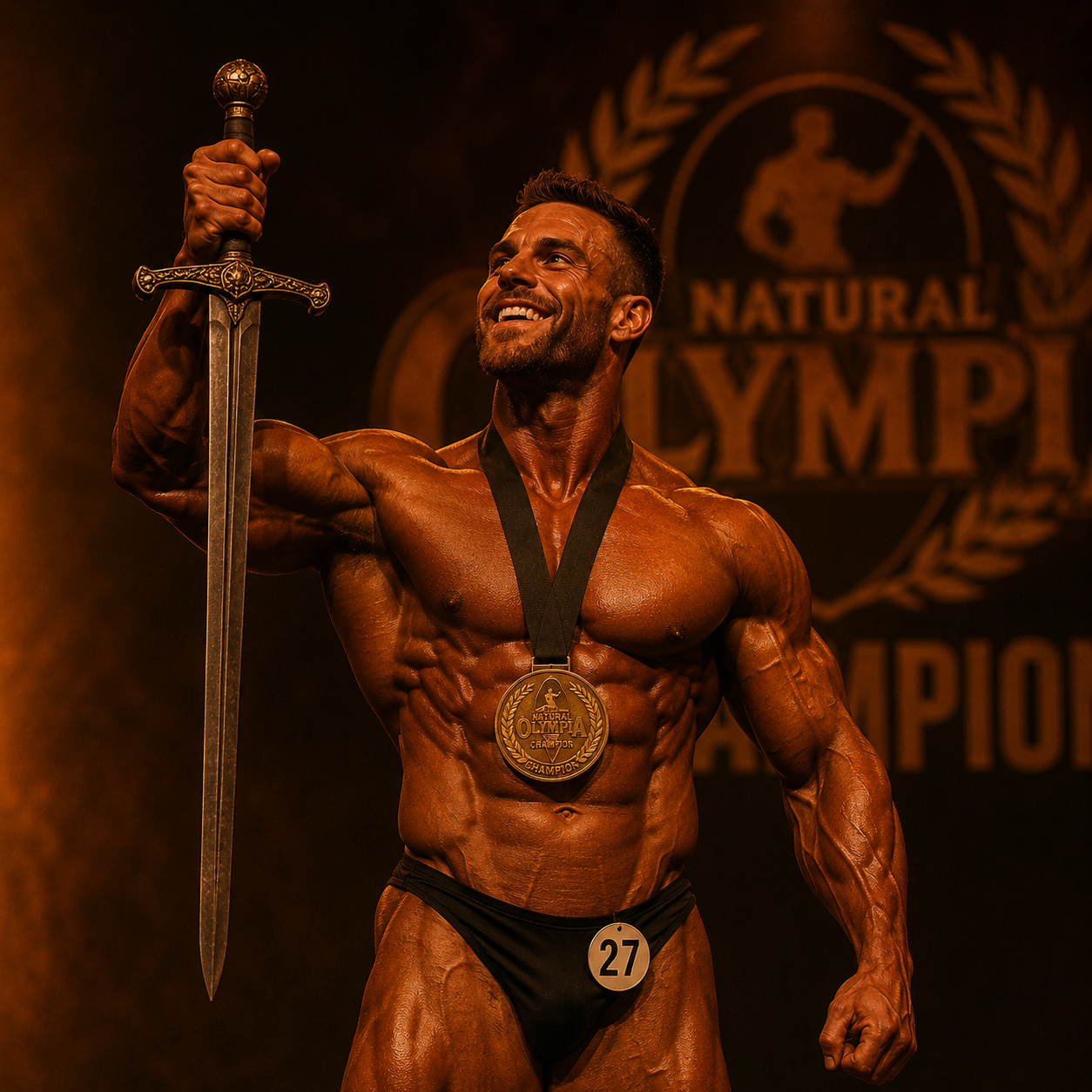
One of my favourite moments of the conversation was when he was showing me his bodybuilding trophies. He stood up and fetched a gleaming gold and silver coloured sword, which he described as “pretty badass”. He had been presented with it as champion of the Sunshine Coast Classic bodybuilding competition.
Five years before winning the competition, Connection 83 wasn’t particularly into the gym. Up until then, he’d had a “live for the weekend” lifestyle, which he felt had been wearing him down. He said, “Over time, that sort of lifestyle slowly deteriorated my physical and mental health. I wanted a bit of a change, and I got into gym in 2020.”
As he developed momentum building his physique, he set his sights on becoming competitive. Speaking about the mentality he developed, he said, “I’ll do what other people aren’t willing to do. People always chase comfort in life. That’s what prevents people from reaching their full potential.”
Fitness seemed to have laid out a mentality blueprint for his life: “If you’ve got a really good routine around training, that’s going to translate over to everyday life because you’re essentially doing something difficult on a daily basis. You’re challenging yourself. You’re pushing yourself. You can then translate that dedication over to other things in life.”
What feels important to me as I’m reflecting on this conversation is that he hadn’t always operated with that same mentality. Maybe it was there before, but dormant. Or maybe it was built incrementally, over time, through repetition and evidence. That feels like a more realistic and helpful way to view it.
One thing I have more certainty about, though, is the importance of dealing with the discomfort in the early stages of a journey. He said, “Anyone who’s achieved any appreciable success has done so with minimal comfort during the early stages of achieving that success.”
Insight 84: Another Insight About Purpose? Yes
Purpose has been a key thread throughout this project. And so, it was prominent theme with Connection 84.
He was a Native American man in his sixties and currently serves on the board of economic development for his tribe.
Prior to this, he’d had a winding career. He’d been a crew chief in the Air Force, a forest fire fighter, a school janitor, bus driver, carpenter, coach, IT consultant for schools. He’d also worked in the mining industry, before spending a decade as a teacher.
When I asked which work he had found most purposeful, he responded simply, “Teacher.”
In 1993, aged 42, he suffered an aneurysm. This meant he had to leave behind his physically demanding job in construction. He decided to go back to school and qualify as a teacher so that he could teach at the tribal community college.
He summarised the purpose in his teaching: “To show that we [Native Americans] are equally intelligent, and we can do just as good at work as anybody.”
As the conversation developed, the sense of purpose became deeper and clearer.
He had grown up without a father from the age of eight. His mother did her best to raise him alone. Despite getting into plenty of trouble growing up, one message from his mother stuck with him: “She always told me that I needed to have a life of purpose. God just didn’t put me here to exist. I needed to make a difference in this world, so I always tried to do that and live by that.”
Later, when life demanded that he raise three daughters of his own as a single dad, he found the highest of purposes. “I was constantly having to work seven days a week, 16 hours a day, to make sure that my girls were covered on costs for their school and their education.”
Financial support wasn’t the only driver though. He wanted his daughters to know they could talk to him about anything. It was critical to be able to support them. He remembered rushing to school as one of his daughters had just got their first period. She was embarrassed and ashamed, and he – understandably – didn’t know what to do. In that moment, he made her feel safe and supported, so that she could tell him what she needed. He headed off to the store. I like to imagine he returned with every possible feminine product he could find on the shelf.
Being both emotionally and physically available for his three daughters has continued into their adulthood. They still have their “daily talks about life” and possess “really strong relationships”. He proudly told me all three daughters are “educated” and thriving in their careers. It sounded like he had lived his life very much in service of his family.
I’m sure his own mother would be proud of him.
Insight 85: Humans Are Big, Messy, and Complicated
“A big, gay hillbilly”.
That was one of the most striking descriptions of Connection 85 I’d found online. A proud self-description too, I believe.
He had been introduced as a poet, professor, and all-round excellent person by Lee Keylock (Connection 81). His first email response was full of love. After Lee told him about the project, he described it as, “Very interesting, very human, and very BIG. That makes me happy. Humans are big. Complicated. Messy.”
I knew immediately I was dealing with a real human who was making an effort to put his authentic self front and centre.
When his face popped up on my screen, and I noticed a distinctive pair of rainbow-coloured glasses, I smiled and knew inside that we were primed for a good conversation.
The headline story you’d find online about Connection 81 is that shortly after being named Kentucky Teacher of the Year in 2022, he resigned. There were repeated accusations against himself – an openly gay man – and the LGBTQ+ students at his school of being “groomers”. He was harassed and verbally abused, before eventually quitting as the toll it took on his mental health was too much to bear.
The situation was a long time coming. In his first week of teaching, 12 years prior, he was warned by a school administrator, “You will be crucified. No one will protect you, including me.”
It wasn’t a new sensation for him, to feel like he didn’t belong. That there was something wrong about him.
He’d grown up in the Appalachian Mountains, in a heavily conservative, religious community. He knew from an early age he was different: “I think I spent a lot of my childhood not really feeling human.” He used to play games pretending he was an “extraterrestrial from some faraway place, sent here to observe”. His imagination “kept him safe”.
In his book Gay Poems for Red States, he talks about taking cover behind church pews, playing with matchbox cars on the floor, as the pastor sent “hellfire” throughout the church. He feared his “little gay body would soon burn in hell”.
I’ve never really been into poetry. Let alone poetry inspired by events which, on the surface, are so different from my own life experiences. Yet, they’re crafted so beautifully, and come from a place of such pain, that it’s hard not to feel them.
My copy sits on my office desk, and I whenever I pick it up, I’m moved. And when I wonder why I’m moved, I think some explanation can be found in his first email response. Humans are big, messy, and complicated.
That’s real and that’s relatable.
Click here to read a few of Connection 85’s poetry.
Summary
These five conversations reminded me to put my phone down, that having true purpose is an honour, and that humans are complicated and messy (and that’s good). A bodybuilder on the other side of the planet reminded me to push through the hardest bit of anything: the start. And Lee Keylock from Narrative 4 asked me a question I can’t forget: “How are you healing the world?”
Next time: connections 86-90.